





Dublin is a city where every cobblestone seems to whisper a secret and every Georgian facade hides a century of drama. To walk through the Irish capital is to journey through layers of Viking settlements, British imperial ambition, and the fiery birth of a modern republic. For those looking to peel back these layers, exploring the city through https://www.generationtours.com/dublin provides an immersive way to see how the architecture of the past dictates the vibrant culture of the present.
The Stories Behind Dublin’s Most Famous Streets and Buildings
The Grandeur of O’Connell Street: A Nation’s Spine
O’Connell Street is one of the widest boulevards in Europe, but its significance is far more than aesthetic. Originally known as Drogheda Street and later Sackville Street, it was renamed in 1924 to honor Daniel O’Connell, “The Liberator,” whose massive monument stands guarding the entrance to the street at O’Connell Bridge.
The General Post Office (GPO)
The GPO is perhaps the most iconic building in Ireland. Designed by Francis Johnston and completed in 1818, its Greek Revival portico is still scarred with bullet holes from the 1916 Easter Rising. This was the headquarters of the rebel leaders, where Patrick Pearse read the Proclamation of the Irish Republic. Today, it stands as a working post office and a shrine to Irish independence.
The Spire and the Pillar
Where the 120-meter-tall Spire of Dublin now stands, Nelson’s Pillar once dominated the skyline. Erected in 1809 to celebrate Admiral Lord Nelson, it was blown up by former IRA members in 1966. The Spire, completed in 2003, represents a new, forward-looking Ireland — a “monument to nothing” that reflects the changing light of the Dublin sky.
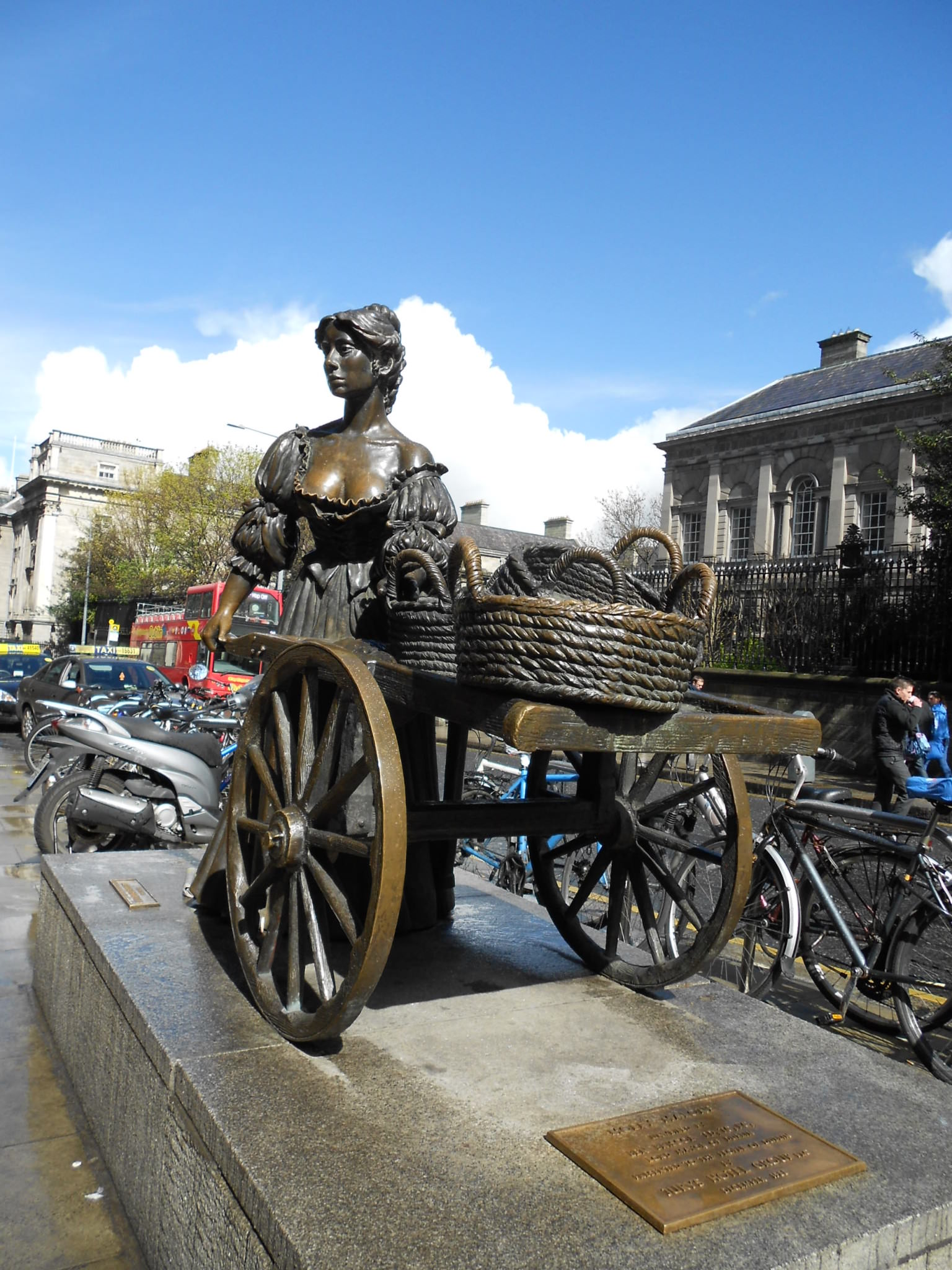
The famous Molly Malone statue and wheelbarrow, in Dublin’s Fair City!
Trinity College and the Cobbles of Knowledge
Founded in 1592 by Queen Elizabeth I, Trinity College Dublin is an academic fortress in the heart of the city. The campus serves as a transition point between the medieval city and the Georgian expansions.
The Long Room within the Old Library is often cited as one of the most beautiful rooms in the world. It houses the Book of Kells, a 9th-century illuminated manuscript of the four Gospels. According to The Library of Trinity College Dublin, the Long Room also holds the Brian Boru harp, a national symbol of Ireland, and one of the few remaining copies of the 1916 Proclamation. The architecture of the library itself, with its barrel-vaulted ceiling and marble busts of great philosophers, reflects the Enlightenment values that shaped the minds of students like Oscar Wilde and Samuel Beckett.
Grafton Street and the Southside Elegance
If O’Connell Street is the city’s political heart, Grafton Street is its social soul. Developed by the Dawson family in the early 18th century, it evolved from a residential lane into the city’s premier shopping destination.
- Bewley’s Oriental Cafés: Opened in 1927, Bewley’s is a Dublin institution. With its Harry Clarke stained-glass windows and mahogany interiors, it has been a meeting place for writers and thinkers for nearly a century.
- The Statue of Molly Malone: At the foot of Grafton Street (now relocated slightly to Suffolk Street) stands the bronze tribute to the fictional “tart with the cart.” While the song is a ballad, the statue has become a focal point for folklore and tourism.
Dublin Castle: The Seat of Power
For 700 years, Dublin Castle was the nerve center of British rule in Ireland. Its architecture is a patchwork of eras. The Record Tower is the only surviving part of the original 13th-century medieval fortress, while the State Apartments reflect the opulence of the Viceroys who governed in the name of the Crown.
The transition of the castle from a symbol of colonial oppression to a site of democratic ceremony is profound. It was here in 1922 that Michael Collins took over the castle from the last Lord Lieutenant. Today, it is where Irish Presidents are inaugurated. The history of the site is meticulously preserved by the Office of Public Works (OPW), which manages the site as a key cultural landmark.
The Liberties and the Guinness Legacy
To the west of the city center lies The Liberties, one of Dublin’s oldest and most characterful neighborhoods. Historically outside the city walls, it was a place of industry, weaving, and distilling.
St. James’s Gate
No story of Dublin is complete without Arthur Guinness. In 1759, he signed a 9,000-year lease on a small, dilapidated brewery at St. James’s Gate. The Guinness family didn’t just brew stout; they shaped the city. They funded the restoration of St. Patrick’s Cathedral and built the Iveagh Trust buildings to provide decent housing for the poor. The massive black gates and the smell of roasting hops remain a permanent fixture of the Dublin sensory experience.
The Two Cathedrals
Dublin is unique in having two medieval Protestant cathedrals — Christ Church and St. Patrick’s — and no Catholic cathedral (the Pro-Cathedral on the Northside serves that role).
- Christ Church Cathedral: Founded around 1030 by the Viking King Sitric Silkenbeard, it sits on the highest ground in the city. Its crypt is the largest in Ireland and contains a mummified cat and rat, famously mentioned by James Joyce.
- St. Patrick’s Cathedral: Built next to a well where St. Patrick is said to have baptized converts, it is the National Cathedral of the Church of Ireland. Its most famous Dean was Jonathan Swift, the author of Gulliver’s Travels, who is buried within its walls.
Temple Bar: From Industrial Slum to Cultural Quarter
While now known for its nightlife and brightly painted pubs, Temple Bar’s history is one of survival. The area takes its name from the Temple family, who owned the land in the 17th century (“Bar” referring to a walkway along the river).
By the mid-20th century, the area had fallen into decay and was slated to be demolished to build a central bus station. However, while the project was delayed, artists and small businesses moved in, creating a bohemian atmosphere that eventually led the government to abandon the bus station plan and instead designate Temple Bar as Dublin’s “Cultural Quarter” in 1991. Today, the narrow medieval street pattern remains, housing galleries, film centers, and the famous red-fronted Temple Bar Pub.